

OEM vs ODM: Which Is Better for Your Laptop Business?
Post Author:
GetMI Team
Date Posted:
April 18, 2026
Share This:
Choosing between OEM (Original Equipment Manufacturer) and ODM (Original Design Manufacturer) is a key decision for any laptop business. This choice influences product positioning, cost control, development timelines, and overall competitiveness. A clear understanding of both models helps businesses build a supply chain strategy that supports long term growth.
What Is OEM in the Laptop Industry?
OEM refers to a manufacturing model where the brand owner defines the product specifications, and the manufacturer produces the laptops based on those requirements. In this arrangement, the brand maintains full control over design, performance, and component selection, while the manufacturer focuses on execution and production efficiency.
How OEM Works in the Laptop Supply Chain
In the OEM model, the brand defines the laptop design, including key components and performance requirements. The manufacturer then handles sourcing, assembly, and production based on these specifications.
This approach allows full control over product design and differentiation, but requires higher investment and longer development time.
What Is ODM in Laptop Manufacturing?
ODM refers to a model where the manufacturer handles both product design and production. The buyer selects an existing design or requests limited customization, then markets the product under its own brand.
How ODM Combines Design and Production
In the ODM model, manufacturers provide ready made laptop designs and handle production. Buyers select a base model and apply limited customization such as branding or configuration.
This approach reduces development time and cost, making it suitable for fast market entry. However, product differentiation is limited, so companies often compete through branding and sales channels.
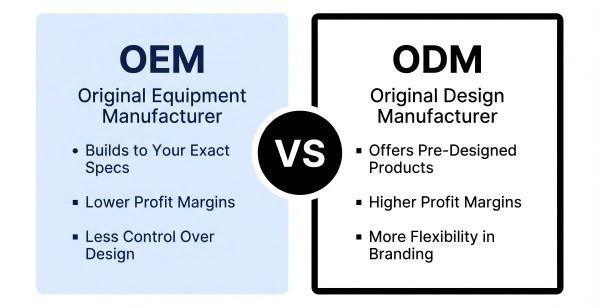
Key Differences Between OEM and ODM for Laptop Businesses
For laptop brands, the real difference between OEM and ODM lies in how control, cost, and speed are balanced across the product lifecycle.
Product Design Control: Custom vs Standard Solutions
Product control is where the gap becomes most visible. With OEM, design decisions stay entirely with the brand, allowing products to be built around specific performance targets or user groups.
ODM works differently. Instead of starting from scratch, companies choose from existing platforms and make limited adjustments. This makes development faster, but also sets clear boundaries on how much the product can be shaped.
Cost Structure and Profit Margin Comparison
The cost profile of these two models follows different timelines. OEM requires heavier upfront investment in design and validation, but it creates room for stronger pricing power later.
ODM lowers the initial financial barrier. Products can be launched with less capital, though similar offerings in the market often lead to tighter margins.
Technical Requirements and Resource Investment
Building through OEM means taking on full responsibility for product development. This includes engineering decisions, component selection, MOQ planning, and coordination across the supply chain.
With ODM, much of this complexity is handled externally. Companies can operate with smaller teams and shift their focus toward market expansion rather than technical execution.
Brand Differentiation and Competitive Advantage
The impact on branding becomes clear over time. OEM makes it easier to develop a distinct product identity, since the hardware itself reflects the brand’s positioning.
ODM leads to a more crowded product landscape at the hardware level. In this case, competitive advantage is usually built through marketing, channel strategy, and speed to market.
OEM vs ODM: Which Model Is Better for Different Business Scenarios?
There is no single model that fits all laptop businesses. The better choice depends on your business stage, target market, and available resources. In practice, companies often choose based on how quickly they need to launch and how much control they want over the product.
Best Model for Cross-Border E-commerce Sellers
For cross-border e-commerce sellers, speed and flexibility are usually the top priorities. ODM is often the more practical option in this scenario. Ready made designs allow sellers to launch products quickly, test different markets, and adjust configurations based on demand.
Lower upfront investment also reduces risk, which is important when operating across multiple regions with uncertain demand. Since competition is often price driven, success depends more on listing optimization, pricing strategy, and logistics efficiency than on deep product customization.
Private Label Laptop Brand Development Path
For companies aiming to build a long term private label brand, OEM becomes more relevant over time. Greater control over design makes it possible to create products with clear positioning and consistent user experience.
Many brands start with ODM to enter the market quickly, then gradually shift toward OEM as they gain market insight and resources. This transition allows them to move from selling standard products to building differentiated offerings, which is essential for long term brand value.
| Business Scenario | Recommended Model | Key Reason |
| Cross-Border E-commerce Sellers | ODM | Fast launch and low investment |
| Early-Stage Private Label Brands | ODM → OEM (gradual shift) | Start fast, then build differentiation |
| Established Laptop Brands | OEM | Full control and strong differentiation |
| Niche Market Players (Gaming, Industrial, Education) | OEM | Customization for specific needs |
| Cost-Sensitive High Volume Sellers | ODM | Lower cost and stable supply |
Why Choose GetMi for Laptop & Tablet PC OEM/ODM Manufacturing?
Choosing the right manufacturing partner is critical for product quality, delivery reliability, and long term business growth. GetMi combines flexible OEM and ODM capabilities with proven production systems and global compliance standards.
Customization for Your Brand Needs
GetMi supports both OEM and ODM projects with flexible customization options. From hardware configuration to product appearance, solutions can be aligned with different market segments and brand positioning.
Fast Delivery and Reliable Production Capacity
Production stability is supported by a 3,500 square meter dust free workshop and automated Industry 4.0 production lines. This allows GetMi to maintain consistent output and reliable lead times.
With a sample lead time of 3 to 7 days and responsive support, clients can move quickly from product validation to mass production, which is especially valuable in fast changing markets.
Advanced Manufacturing and Strict Quality Control
Quality control follows a structured system with 10 key inspection processes and 35 checkpoints across the production cycle, covering incoming materials, in process control, and final testing.
All products comply with global standards, supported by over 100 certifications including ISO9001, CE, FCC, and RoHS. This ensures products are ready for international markets and major retail channels.
FAQ
Can small businesses use OEM manufacturing?
Yes, but it depends on available resources. OEM requires higher investment in product design, development, and supply chain management. Small businesses can use OEM if they have clear product positioning and sufficient technical support, otherwise ODM is often a more practical starting point.
Is ODM suitable for startups?
Yes. ODM is widely used by startups because it allows fast product launch with lower upfront cost. With ready made designs and simplified development, startups can enter the market quickly and test demand before investing in deeper customization.
Which model offers better profit margins?
OEM generally offers higher profit potential due to product differentiation and brand positioning. ODM provides lower initial cost and faster entry, but margins are usually more competitive because similar products exist in the market.
Conclusion
OEM and ODM serve different business needs. OEM is suitable for companies that want full control and long term brand differentiation, while ODM is ideal for fast market entry and cost efficiency.
The best approach is often a staged strategy. Many businesses start with ODM to validate the market, then move toward OEM as they grow and seek stronger product identity. Choosing the right model depends on your resources, timeline, and business goals.