

Laptops in Wholesale: Specs, QC and Branding Guide
Post Author:
GetMi Team
Date Posted:
July 7, 2026
Share This:
Freeze the approved sample before ordering wholesale laptops. Match the quote, branding files, OS setup, and production checks to the same record.
Bulk orders often fail through small changes: CPU options shift, keyboards change, chargers miss the target plug, or box art arrives late. These changes create returns, certificate gaps, and launch delays before the buyer can sell the batch.

What Should Buyers Check Before Ordering Laptops in Wholesale?
Wholesale laptop buyers should check use case, target market, sample approval rules, payment terms, and production terms before price comparison.
Confirming the Buyer Use Case and Target Market
A laptop for school tenders does not carry the same risk as a laptop for retail shelves. Education buyers often care about battery behavior, keyboards, chargers, and repair flow. Resellers often care about screen size, box presentation, barcodes, and repeatable SKU names.
Define the target country, sales channel, buyer use case, screen size range, and performance tier before asking for a quote. Add keyboard language, OS language, ports, chargers, adapters, wireless setup, packaging, labels, barcodes, and manual needs. This buyer brief helps prevent a quote for a device that looks cheap but creates returns, certificate gaps, or launch delays.
Freezing the Approved Sample
Use the approved sample as the control device for the bulk order. Keep a written sample record with model name, configuration, photos, serial number, BIOS or OS notes, packaging files, and signed approval date.
Compare mass production against that record, not against a loose email thread. A sample record reduces the risk of changed screens, substituted memory, wrong keyboards, missing drivers, or different chargers.
Reviewing Sample, Payment, and Production Terms
Price alone does not protect a wholesale laptop order. The buyer should review the quote, sample approval point, payment trigger, inspection point, and production release step together.
| Term to approve | What to check | Buyer risk if skipped |
|---|---|---|
| Sample scope | Device specs, logo, OS image, packaging mockup | The sample passes, but the ordered batch changes |
| Payment terms | Deposit, balance timing, inspection before balance | The buyer loses control before shipment |
| Production release | Signed sample, final BOM, artwork, labels | The factory starts before the buyer approves files |
| Change control | Who can approve CPU, RAM, SSD, screen, charger, or packaging changes | A substitute part reaches customers without warning |
| Shipment condition | Packing method, carton marks, document list | Customs or warehouse teams reject the shipment |
The order path should move from needs review to feasibility approval, sample, testing, trial order, and mass production. Attach order files to each step so the approval trail stays visible.
Which Laptop Specs Matter Most in Bulk Orders?
CPU, RAM, storage, screen size, keyboard language, OS image, drivers, ports, chargers, and wireless setup matter most because those fields decide performance, return rates, and repeat-order stability.
CPU, RAM, Storage, and Screen Size
The CPU should match the real workload, not the highest number on the quote. Office, education, and reseller laptops may need different performance targets, battery behavior, and price points.
Build the spec table before the buyer asks for a final price:
| Spec field | Buyer action | Risk to control |
|---|---|---|
| CPU platform | Pick the minimum acceptable platform and acceptable alternates | Performance complaints and unsupported substitutions |
| RAM | Confirm capacity, type, and upgrade expectation | Slow devices or mismatched product listings |
| Storage | Confirm SSD capacity and grade expectation | Low perceived value or support tickets after launch |
| Screen size | Match use case, bag fit, desk space, and box size | Wrong product fit and higher freight cost |
| Touch screen | Confirm whether the exact model supports touch | Confusing a laptop with a touch laptop |
| Battery | Ask for test data for that model before publishing runtime | Unsupported runtime claims |
GetMi’s current wholesale laptops cover compact, mainstream, and large screen models, but buyers should check exact CPU, battery, weight, and touch details against the raw product page before publishing public specs.
If a quote names a sample model such as GetMi Lite 140C Laptop, keep that model name tied to the approved CPU, RAM, SSD, screen, charger, keyboard, and OS record. Apply the same rule to alternate models offered during price negotiation.
Keyboard Language, OS Image, and Drivers
Keyboard language and OS setup can break a bulk order even when hardware specs look correct. A US buyer may need a US keyboard, English OS language, matching recovery setup, and driver package notes. A school or enterprise buyer may need the same image across every device in the batch.
Before production starts, approve the keyboard layout, printed language, OS language, OS edition, and activation responsibility. Lock the license documents, driver package, recovery process, update policy, and any BIOS settings that affect boot, security, or service handling.
GetMi supports software setup, but the quote needs Windows activation terms and license handling before production starts.
Ports, Chargers, Adapters, and Wireless Setup
Ports decide whether the laptop works with the buyer’s desks, classrooms, displays, docks, and networks. A missing HDMI, USB-C, LAN, or charging detail can cause returns even when the laptop powers on.
Before the quote locks, approve the HDMI or Micro HDMI requirement, USB-A and USB-C count, wired LAN or adapter need, charger wattage, and target country plug. Add WiFi and Bluetooth version expectations, plus any docking, projector, or portable monitor use.
If buyers need stable wired networking, confirm laptop Ethernet ports before the quote because a later adapter fix adds cost and support friction.
Matching Specs to Repeat-Order Needs
A wholesale laptop order should protect future reorder stability as well as the first shipment. The buyer should ask which parts, screens, chargers, keyboard layouts, and packaging files GetMi can repeat across future batches.
Repeat-order planning reduces SKU confusion. GetMi can quote alternates when needed, but the buyer should approve every alternate in writing before the factory uses that part in production.
How Can Buyers Reduce QC Risk Before Shipment?
Buyers reduce QC risk by comparing mass production with the approved sample, testing core functions, reviewing inspection records, and approving fixes before packing.
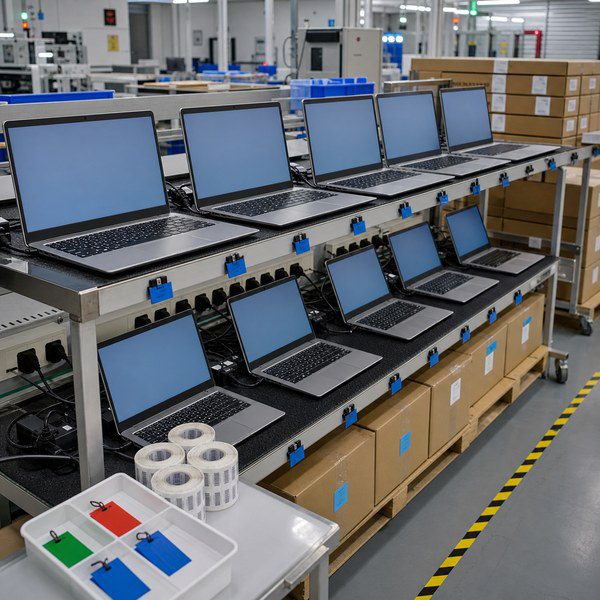
Comparing Mass Production with the Approved Sample
The approved sample should sit beside the first production units during inspection. The inspector should check physical appearance, screen size, ports, keyboard print, logo, OS language, charger, label, and packaging against the sample record.
This comparison catches small changes that create large buyer problems. A changed keyboard, dull logo finish, wrong adapter, or different box insert may not stop the laptop from turning on, but those issues can stop a launch.
Testing WiFi, Battery, Charging, and Display
Laptop QC should include functions that customers notice first. Power-on checks alone do not expose weak WiFi, charging faults, screen defects, sleep issues, or fast battery drain.
Use a practical QC checklist that covers the functions buyers notice first:
| Function | What to inspect | Buyer pain point |
|---|---|---|
| WiFi | Connect, browse, and check signal stability | Returns blamed on weak hardware |
| Battery | Charge, discharge, and compare against approved test method | Runtime complaints and warranty pressure |
| Charging | Test charger, port fit, plug type, and adapter heat | Arrival failure claims |
| Display | Check brightness, dead pixels, touch if applicable | Visible defects and resale disputes |
| Keyboard and trackpad | Test every key, language print, and touch response | Local market complaints |
| Thermals | Run a workload test when the product tier needs it | Stability risk and support cost |
Use the same test method for the sample and production units, because changing the test can hide batch drift.
Checking Inspection Records and QC Photos
Inspection records should show what the factory checked and how the batch “passed.” Useful records include sample comparison photos, function test logs, defect counts, repair notes, packing photos, and carton label photos.
GetMi publishes company QC checks, including 10 inspection processes and 35 checkpoints. Buyers should still request batch proof, because a company process does not prove that one laptop batch used the right keyboard, charger, and OS image.
Approving Fixes Before Packing
Fixes should happen before cartons close. Once packing starts, logo defects, wrong labels, missing inserts, or charger errors become slower to find and more expensive to correct.
Before cartons close, approve the defect list, root cause, rework method, replacement part source, retest record, new repair photos, and packing release. This approval step gives the buyer a record if the same defect appears after shipment.
What Branding Details Should Buyers Approve Before Production?
The buyer should approve logo, boot screen, wallpaper, OS language, retail box, manuals, labels, barcodes, and artwork files before the hardware sample moves toward production.
Logo Position and Finish
Logo approval needs more than a placement note. The buyer should approve size, position, color, finish, surface material, and photo samples under normal light. On wholesale laptops, a logo that looks acceptable in a digital mockup can look weak on a textured shell. The buyer should inspect a physical sample before mass production.
Boot Screen, Wallpaper, and OS Language
Software branding affects first boot. The buyer should approve boot logo, wallpaper, OS language, user setup flow, default apps, driver package, and recovery behavior.
This software record helps prevent firmware inconsistency across the batch. A reseller does not want customers opening laptops with mixed languages, old drivers, or different setup screens.
Retail Box, Manuals, Labels, and Barcodes
Packaging should match the sales channel. A distributor may need neutral cartons. A retail buyer may need branded boxes, barcodes, manuals, warranty cards, and country-specific labels.
Before mass production, approve the retail box dieline, print proof, manual language, warranty wording, and serial number rules. Lock the SKU format, barcode format, carton marks, pallet labels, accessory list, and insert layout. Custom packaging changes shipping space and warehouse scanning, so packaging approval should happen before the production slot closes.
Artwork Files That Can Delay Launch
Late artwork slows launch even when laptop production is ready. Buyers should send editable logo files, Pantone values, box dielines, manual files, barcode rules, and label placement notes before sample approval.
If the order includes custom brand laptops, artwork approval should sit on the same timeline as the device sample, not after the device sample passes.
What Should Buyers Send Before Asking for a Quote?
Buyers should send quantity, target market, use case, specs, customization notes, certificate needs, shipping country, packing rules, artwork files, and sample approval notes before asking for a wholesale laptop quote.
Quantity, Target Market, and Use Case
Quantity affects the quote, but quantity alone does not define the order. GetMi also needs target country, buyer type, sales channel, and use case.
Buyers serving price sensitive markets should state the expected configuration before quoting, because the same laptop may need different keyboard, charger, OS, packaging, and certificate files. Include the order quantity, expected repeat quantity, target country, shipment country, sales channel, main use case, and target price range if the buyer has one. Tender, retail, distributor, online store, school, and enterprise orders often need different laptop specs and packing files.
This brief helps GetMi quote a realistic laptop instead of a low price device that misses the buyer’s market.
Required Specs and Customization Notes
The buyer should send required specs and allowed alternates. For example, a buyer can name required screen size, CPU tier, RAM, SSD, keyboard language, OS image, logo, box type, and charger plug.
The RFQ should name allowed alternates. If GetMi offers another CPU, panel, memory grade, or charger, the buyer should approve the change before production.
Certificate Needs and Shipping Country
Certificate needs depend on the market and product family. A company level certificate does not automatically prove that one laptop SKU meets the buyer’s import or retail requirement.
Include these RFQ details:
- Destination country
- Required certificate files
- Importer or retailer document list
- Battery shipping document needs if applicable
- Label and manual language rules
Do not publish or import under SKU certificate claims until GetMi provides certificate files.
Packing Rules, Artwork Files, and Sample Approval Notes
Packing rules should be part of the RFQ, not a late email after price approval. Send box dimensions if fixed, carton mark rules, barcode rules, manual files, accessory list, and pallet needs. The RFQ should still include files for that order. Without those files, the quote can miss branding cost, and the production slot can follow the wrong packing plan.
FAQs
What Is the Minimum Order Quantity for Wholesale Laptops?
Laptop MOQ depends on the model, customization level, packaging, and supplier policy. Confirm the MOQ with GetMi sales for the exact laptop, because private label work, custom packaging, and trial orders may use different thresholds.
Are Wholesale Laptops New or Refurbished?
GetMi wholesale laptop quotes should state product condition in writing. Buyers should not assume condition from price or product photos, because unclear condition wording creates customer disputes, warranty pressure, and import risk.
Can Wholesale Laptops Come with Windows Already Activated?
Wholesale laptops can ship with Windows setup when GetMi and the buyer confirm the OS edition, activation responsibility, license documents, and market rules in writing. Buyers should not treat a preloaded OS image as proof of proper activation.
What Warranty Should Buyers Ask for Before a Wholesale Laptop Order?
Buyers should ask for written warranty terms that name coverage length, covered parts, defect process, spare parts support, shipping responsibility, and proof required for claims. Confirm warranty terms with GetMi sales before using stronger public warranty wording.
What Import Documents Should Buyers Prepare for Wholesale Laptops?
Import documents for wholesale laptops depend on destination country, order value, battery status, certificate scope, and buyer role. Buyers should ask for commercial invoice, packing list, certificate files, product labels, battery shipping documents when applicable, and any retailer-specific compliance files before shipment.